
Walk into any electronics store and you will find purification efficiency quoted as a percentage so close to 100 that it stops meaning anything. The number is real, but the grade behind it is rarely explained. At INVITOP we build around H13 media, and in this first journal entry we want to be precise about why.
A grade is a test result, not a badge
HEPA classifications come from EN 1822, a European standard that measures how a filter performs at the Most Penetrating Particle Size - the particle diameter that is hardest for that media to catch, typically around 0.1 to 0.3 microns. H13 must retain at least 99.95% of particles at that size; H14 raises the bar to 99.995%. The familiar 99.97% figure belongs to the older US DOE convention and is often mixed into European marketing copy.
That difference - 99.95 versus 99.995 - sounds enormous. In a real room it almost never is, because a purifier is not a sealed test rig. Air leaks around the gasket, the fan has a finite flow rate, and the room itself exchanges air with the outside. Once those factors dominate, the limiting variable is airflow and seal integrity, not the last decimal place of media efficiency.
Why we specify H13 composite media
H14 media is denser. To move the same volume of air through it you need a stronger motor, which means more noise, more power and often a shorter filter life. For a bedroom running eight hours a night, that trade is a bad one. H13 gives near-total particle capture at a pressure drop that allows a 20-24 dB sleep mode and a 24 W DC motor.
- H13 captures PM2.5, pollen, dust, pet dander and mould spores at the most penetrating particle size.
- Lower pressure drop allows quieter fan curves and smaller, more efficient motors.
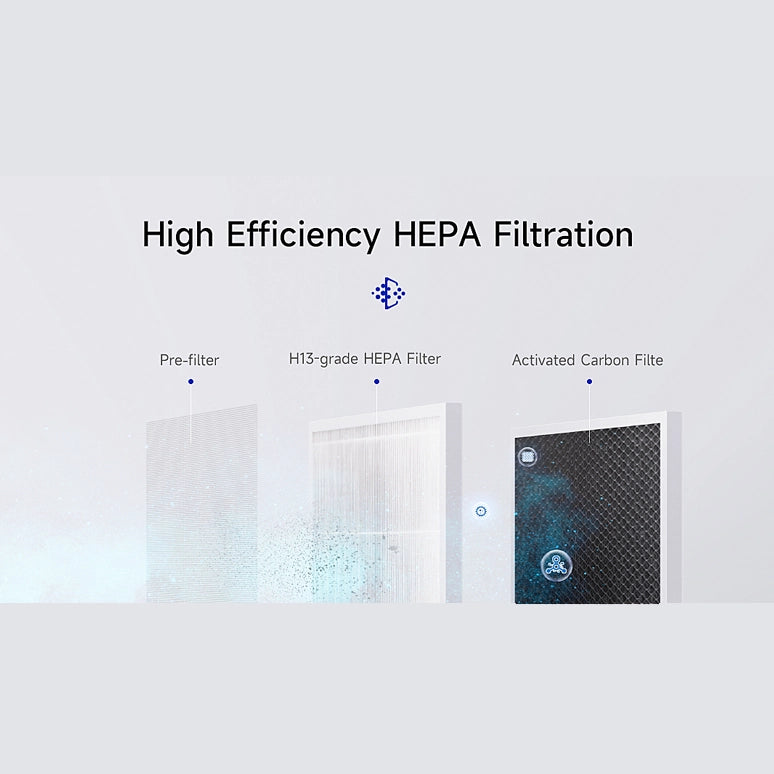
- A composite cartridge adds a washable pre-filter and an activated carbon layer for gases and odours.
- Tool-free replacement means the seal is re-made correctly by the user, every time.
The part nobody advertises: the seal
A filter is only as good as the frame around it. We have measured units where a technically excellent H13 sheet was bypassed by a 2 mm gap at the cartridge edge, dropping whole-machine efficiency by double digits. This is why our cartridges use a compressed gasket and a single-piece frame, and why our replacement guides show the seating step explicitly.
Clean air is a system property. Media grade, seal, airflow and room mixing decide the result together - never one number in isolation.
What to look for on a spec sheet
Ask for CADR (clean air delivery rate) alongside the HEPA grade, check that the manufacturer states the standard used, and look for an honest coverage figure in square metres rather than an aspirational one. If a brand quotes 99.99% but refuses to publish CADR or noise at each speed, the percentage is doing decorative work.
Our own range publishes all three. It is a small discipline, but it is the one that lets you compare a Callisto with a Cody Pro - or with a competitor - on something other than adjectives.