
The small laser sensor that made real-time air quality displays affordable is a neat piece of optics and a flawed piece of metrology. Knowing both halves of that sentence lets you read the number on your purifier sensibly.
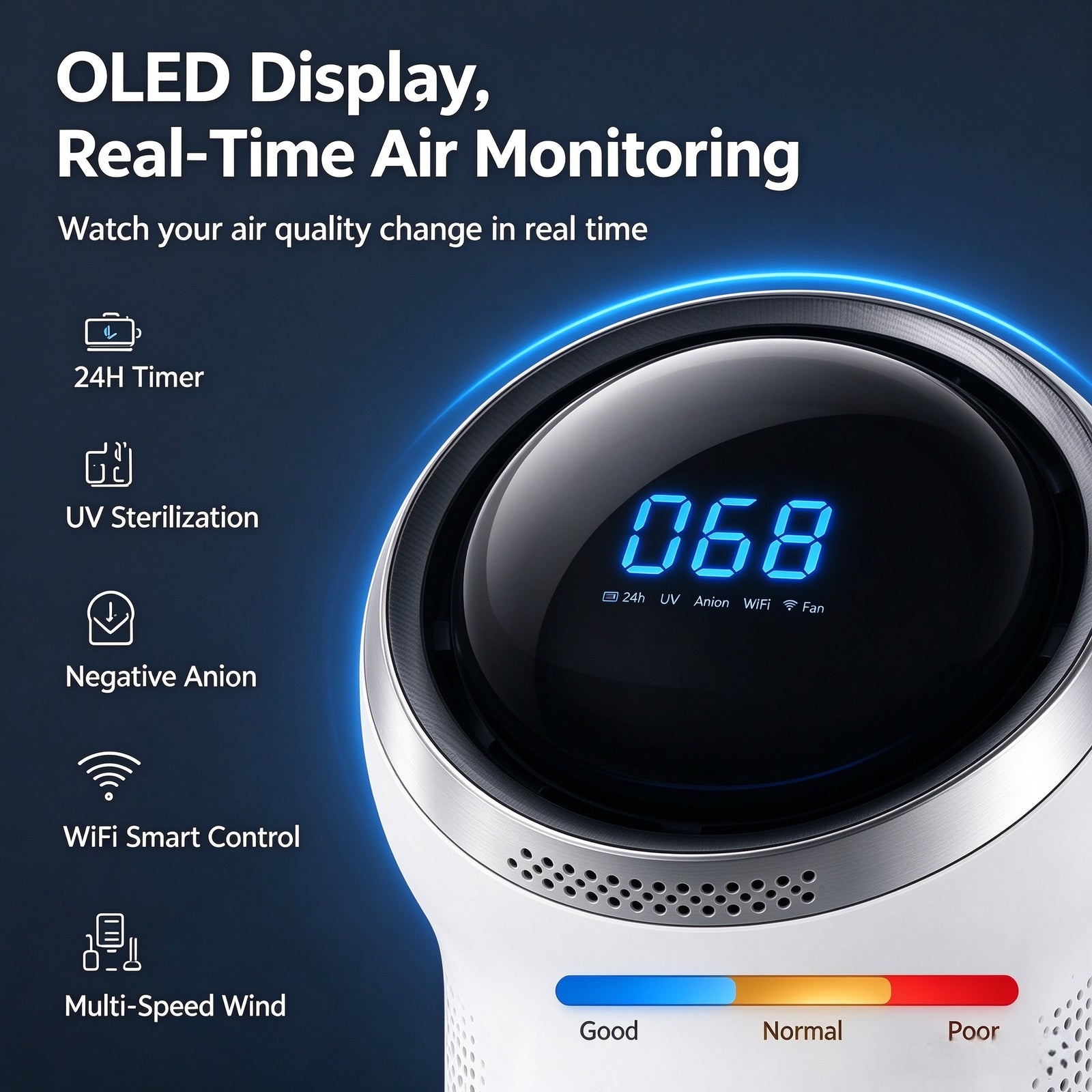
Scattering, not weighing
A reference-grade PM2.5 monitor pulls a known volume of air through a filter, weighs it, or uses a beta attenuation method. That costs thousands of euros. A consumer sensor instead shines a laser across a small chamber and counts the flashes of light scattered by individual particles. A photodiode measures intensity and angle; firmware bins the pulses by size and converts the count into an estimated mass concentration using an assumed particle density and shape.
That conversion is the weak link. The same optical signal can represent a dense mineral dust particle or a fluffy soot agglomerate with very different mass. Humidity above roughly 70% RH causes hygroscopic particles to swell, which the sensor reads as more mass. Steam from a shower, a humidifier mist or a boiling kettle will happily spike a PM2.5 reading.
Where the sensors are genuinely valuable
- Trend detection: a rapid rise after cooking, a slow decline after the purifier ramps up.
- Auto mode: a relative signal is enough to decide whether to increase fan speed.
- Filter-life estimation: cumulative exposure is more useful than a simple hour counter.
- User feedback: seeing the number fall is the single most effective way to convince someone the device is doing something.
Where they mislead
Absolute accuracy against a regulatory reference is typically within 10-20% for a good sensor in ideal conditions, and considerably worse for very small particles below 0.3 microns, for high humidity and for unusual aerosols. Two identical units side by side can disagree by a few micrograms. A reading of 008 is not a laboratory certificate.
Use the number as a direction, not a verdict. What matters in a home is whether it goes down when the fan goes up.
Engineering around the limitations
On our OLED models we place the sensor in a shielded bypass channel away from the outlet jet, apply a humidity-compensated correction, smooth the reading over a short window so the display does not flicker, and hysteresis-band the auto mode so the fan does not hunt between speeds. The app shows a trend rather than pretending to show a regulatory measurement.
The next step, which we began exploring in 2024, is to combine the optical channel with a gas-phase VOC index and runtime data to estimate filter loading. That is the subject of a later entry in this journal - and a good example of why sensor fusion beats any single cheap component.