
Wildfire smoke is mostly fine particulate - a large share below 2.5 microns and a significant fraction below 0.3 microns - mixed with gases. It is exactly the aerosol a mechanical H13 purifier is built for, provided the unit is sized and run correctly.
Create one clean room
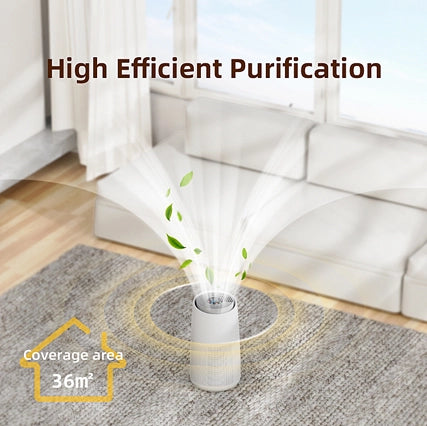
During a smoke event you cannot purify a whole house with one portable unit. Pick a single room - usually a bedroom - close windows and doors, seal the obvious gaps, and size the purifier for 4-5 ACH in that space. A 400 m3/h unit in a 30 m2 room gives roughly 5 ACH on high. Keep the door traffic to a minimum.
Run it continuously on high
- Continuous operation beats short bursts: indoor PM2.5 tracks outdoor levels with a lag, and bursts let it rebound.
- Keep the unit away from curtains and corners; allow 30-50 cm clearance around the intake.
- Avoid ozone-generating air cleaners during smoke events - ozone reacts with smoke VOCs and makes the chemistry worse.
- Turn off anything that burns: candles, incense, gas hobs, unflued heaters.
Understand what the sensor is telling you
Smoke particles are often dark, irregular soot agglomerates. Optical PM sensors calibrated on standard test dust can under-read them, so a display of 035 may represent a worse exposure than the number suggests. Use the reading as a relative trend: if it is falling after the fan ramps up, the strategy is working.
In a smoke event, the goal is not perfect air. It is one room that is measurably, reliably cleaner than outside - for as long as the event lasts.
Filter loading and aftercare
Heavy smoke loads a filter fast. Our guidance is to inspect the pre-filter weekly during an event and expect to replace the H13 cartridge at the short end of the 6-8 month range if the unit has run on high for weeks. A clogged filter reduces airflow, which reduces CADR, which quietly undoes the whole plan. This is why our app estimates loading from cumulative exposure rather than a simple hour count.
Portable units matter here too: a Loko in a hotel room or a car cabin gives a small, personal clean-air zone when you cannot control the building. It is not a substitute for a properly sized room unit, but it is better than nothing.