
Most homes are not one well-mixed box. They are a set of rooms separated by doors, each with its own pollution source and its own air-change rate. Treating them as zones is both more effective and quieter than relying on one large unit in a hallway.
Why the single-unit assumption fails
A closed bedroom door can cut the effective air exchange between rooms by an order of magnitude. A purifier in the living room will show a beautiful PM2.5 reading while the bedroom, where someone is actually sleeping, stays unchanged. Coverage figures silently assume a single open volume.
A practical zoning layout
- Sleeping rooms: a compact unit (Zoe, Mars) sized for 3 ACH, running continuously on sleep mode.
- Main living space: a higher-CADR unit (Callisto, Umi or Cody Pro) on auto, with a boost after cooking.
- Source rooms: kitchens, hobby spaces and entryways get short boost cycles rather than permanent capacity.
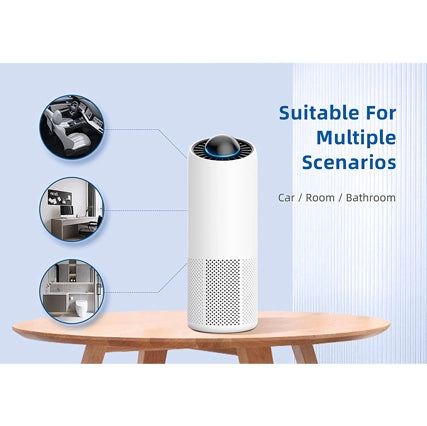
- Transition spaces: portable units (Loko) for cars, hotel rooms and home offices that change week to week.
Two 180 m3/h units placed in the rooms people actually occupy will usually deliver more useful clean air than one 400 m3/h unit in a hallway - at a lower total noise level, because each can run at a gentler speed.
Where to put the sensor
An on-board sensor measures the air at the purifier's own intake, which is the cleanest point in the room. For a whole-home picture, a separate sensor in the far corner of the bedroom is more informative. Keep it away from the outlet jet, humidifiers, kettles and open windows, and give the reading a few minutes to settle before drawing conclusions.
Design for the rooms people live in, not for the floor plan on the brochure.
Coordinating multiple units
In 2026 our app groups units by zone and applies a shared schedule - night guard in bedrooms, evening boost in the living space - while each device keeps its own local auto mode. Grouping is a convenience, not a dependency: unplug the router and every unit falls back to its own sensors and stored schedule. That principle has not changed since our 2024 article on smart features, and it is not going to.